August 5, 2026 · Temple Compute
We put our workflow engine in charge of our codebase
A few weeks ago we asked ourselves a question that usually ends badly: what happens if we let our own workflow engine write our own code?
So we built tc-agent-loop: an autonomous issue-to-PR agent that lives on
our servers and does exactly that. You open an issue in tc-os, comment
/missues, and the loop claims it, plans a fix, implements it, validates it,
and opens a pull request, then keeps working the PR until it's merged.
The part we're proudest of: the agent is not a bespoke script. It's a horus-runtime workflow. The same engine that orchestrates molecular dynamics simulations and bioinformatics pipelines across HPC and cloud is orchestrating coding agents.
The loop
GitHub issue + /missues
        │
        ▼
tc-agent-loop daemon (asyncio)
  ├─ plan     → headless opencode, writes plan.json
  ├─ resolve  → horus workflow: one implement task per plan step
  │              · each task = a headless opencode sub-agent
  │              · apply task captures the diff
  │              · validate task runs lint + type-check
  ├─ PR       → "Closes #N"
  └─ follow-up→ review comments become fix prompts, new implement round
One issue at a time, SQLite state, bounded retries, and guardrails: it never
pushes to main, never auto-merges, and ignores its own comments.
The workflow inside the agent
When an issue is claimed, the loop builds a horus workflow that mirrors the plan. For a three-step plan it looks like this:
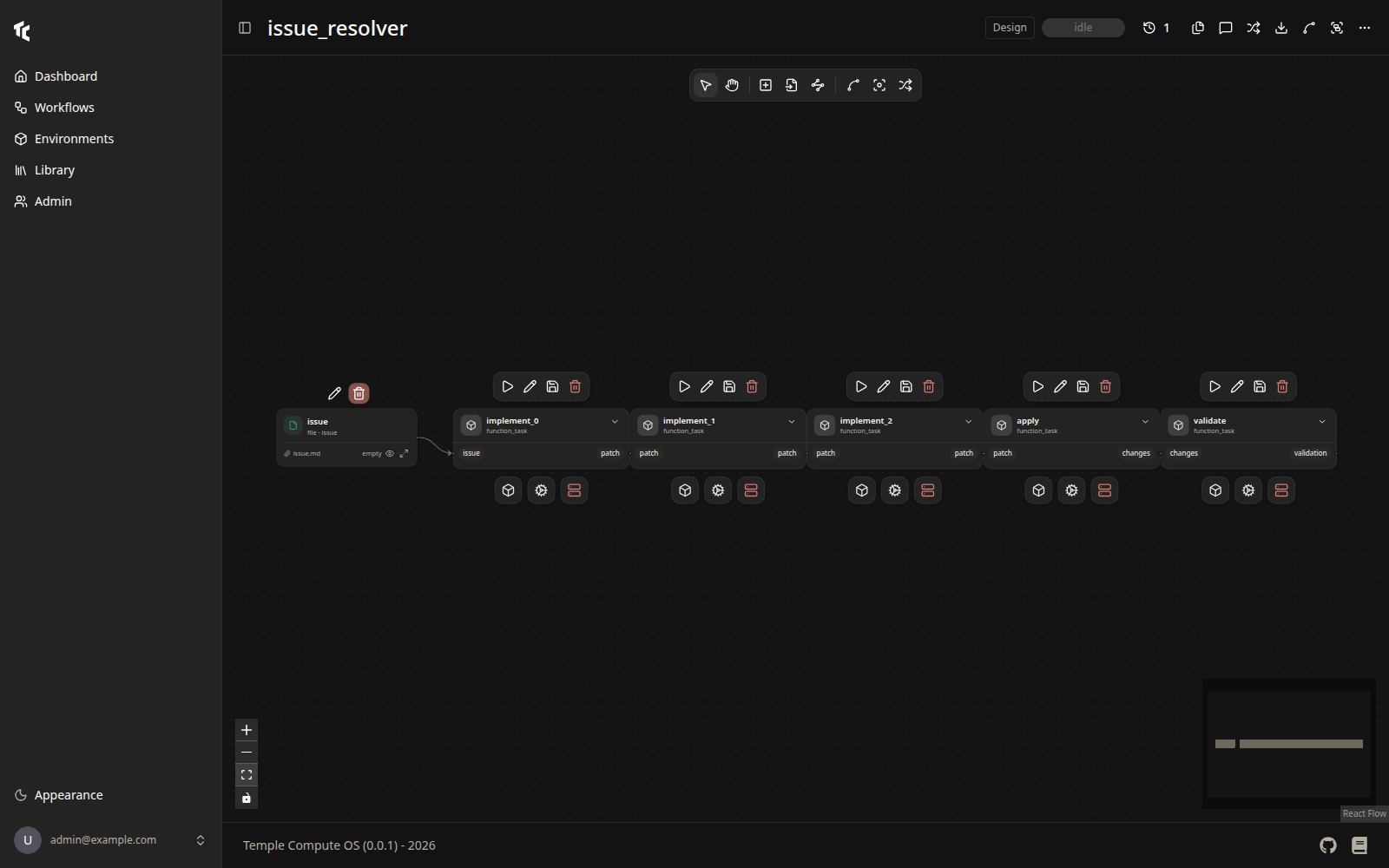 The issue resolver workflow: one implement task per plan step, then apply and validate.
Each implement_N task runs a headless opencode run in a shared git
worktree, so the steps chain safely. apply captures the accumulated diff,
and validate runs the repo's own lint and type-check commands before
anything is pushed. If validation fails, the loop retries the implementation,
up to a bounded number of attempts, before giving up and asking a human.
Why this matters
- Dogfooding with teeth. tc-os already runs horus workflows for scientific pipelines; now it runs them for software engineering too. Same DAG semantics, same artifact model, same failure policies.
- Agents as tasks. A coding agent is just another task implementation: a Python function that happens to spawn an LLM. Everything horus already gives you (chaining, retries, validation, artifact capture) applies to it for free.
- Composable. Want review feedback to trigger a re-implementation? Add an edge. Want to gate the PR on a test job? Add a task. The agent is a graph, so it grows like one.
Try it
The loop runs on our own infrastructure, against our own repository, and is the fastest way we've found to turn "we should fix that" into a reviewable pull request.
Want the managed experience? Temple Compute OS is in early access, including the workflow engine that just wrote this loop.